Showing posts with label Ayutthaya. Show all posts

Tuesday, March 25, 2014

Divergence of the Buddhist Experience

Divergence of the Buddhist Experience

For long, Buddhism has spread and materialize its ideology and teachings through the experience created by architecture and ceremonies that the Buddhist perceive in order to plant and manifest the idea into ones mind. Divergence of Buddhist Experience is a virtual space that allows the user to illustrate and materialize their envisagement of the experience that they desire to enhance the Buddhist practices and ceremonies according to the individual preference. Each contribution from the user will then be used to form a creative network platform that act as an archive to store all the designed virtual spaces that can be shared and accessed by every user. The constructed virtual space must be used to house virtual 16 meters tall Phra Sri San Phet, the same as what the Grand Hall used to function. Each space will then be used for Buddhist practices and ceremonies, accessible by the people onsite and online.

The user who is on the real physical site of Wat Phra Sri Sanphet Grand Hall will be granted access to the design interface via the creative virtual headset consisting of a virtual ocular device with a camera attachment to record the surroundings, a hand gesture recognition device, and a built in open back headphone, allowing them to see, hear, and manipulate the virtual elements respectively, of both the design interface and the constructed virtual space. Only the user onsite will be able to construct the virtual space as they will be able to perceive and scrutinize the context, ambient atmosphere, and variables of the physical site. The user will be given the constructed virtual grammar that act as a foundation where they will be constructing upon. Every architectural design element must be placed on the same existing layout of the ruin.

The design interface aids the user by enabling the new perception through transition of reality such as the ability to see sound, enhancing the creativity and as well as truly understand every single choice and element that they choose. Each choice being made will be shown to the user instantly so that they may experience their creation in real time to achieve the desired effects. They will interact with the design interface through physical body contact with the virtual elements which will response with the user for every certain body gesture. Once the virtual space has been constructed, it will be stored in the online archive of each individual account. It is an interactive platform where different users can access and experience every virtual space through the same medium of the virtual headset and a 3d scanner to record their body and transform that into digital format into the online network. This network allows the Buddhist society from all around the world to form a new community through virtual space that doesn’t just give the user conventional spaces but a holistic archive where contribution creates the network itself. The users are able to interact with other online and onsite user who chooses the same space to perform the practices and ceremonies together.

This interactive network is designed to blur the demarcation of ideology on how Buddhist practices and ceremonies should be experience. Being a core of the space, the Buddha image act as a portal in which the user is able to materialize and manifest their thoughts of the new space should be. This space embraces different perspectives from both Buddhist and non-Buddhist user, creating a divergence to enhance the experience.   
the interior of Divergence of Buddhist Experience

Virtual Grammar


The original Grand Hall design will be use as a default virtual space where both the user onsite and online can come a use this same main channel of Divergence of the Buddhist experience. The space must be use to house a virtual 16 meters tall golden Buddha image. They will be carrying out Buddhist practices and ceremonies in front of the Buddha image.

The user can create their own roof, wall, column, and floor based on the same layout of the Grand Hall ruin. Each element will be a simple mass of architecture. However, the user can manipulate and tweak the surface of each element according to their own desire such as increasing the height of the wall and ceiling. They an add or subtract from all the surface of the elements.

The user can select all natural material to be applied to every architectural elements of their design. The feature was made to embrace the user who is also non Buddhist but choose to contribute to this virtual platform by the individual knowledge of his or her own religion. They can also apply the material to a specific point of the surface, creating a new pattern and atmosphere for the user of the space.


Candles will be the main artificial light source and one of the offerings the user will have. During the Wan Kao Pansa period the user will be able to manipulate the surface an form of the candle at will to create and mould for aesthetic quality. This candle will then be offered to the Buddha Image as the Tawaii Tian ceremony and a way of making merits. Candles can also be placed anywhere in the space to engulf the user with new arrangement of lighting.

Virtual Headset


The virtual glasses will be projecting the image from the world camera to enable the vision of the surrounding. The image of the virtual interface will be overlaid on top of the surrounding image and is interactive through the creative third eye on the top. On top is the creative third eye device is the leap motion sensor that tracks and recognizes the motion and hand gesture to enable the interaction between the user and the virtual interface. Each hand gesture will trigger the stimulation and response of the virtual space. The dual world camera is small in size and is mounted on to the virtual headset as devices for scanning the visual data the user is looking and sent the acquired data to the virtual glasses to be projected to the user. Because this real time virtual interface requires a lot of body movement, the tri lock system will ensure that the virtual headset is properly fasten to the users head without creating any discomfort to the user while carrying out the Buddhist practices and ceremonies. Gilded Thai ornaments are carefully designed onto the virtual headset as a symbol of human according to the pattern of Thai art. Each ornament on different part of the headset is derived from the costume pattern of the human in the Thai pattern, specifically the headwear part.


Final Reasearch: The Grand Hall of Wat Phra Sri Sanphet

   The Grand Hall or Grand Vihara is once used to place the 16 meter tall Golden Buddha called Phra Sri Sanphet.  The is the hall that the Royals used to carry out and perform religious Buddhist ceremonies for the City of Ayutthaya. The plan of the Grand Hall has a strong axis that leads the people towards the Gigantic Buddha Image which was latter destroy by the Burmese army. Most part of the Grand Hall was destroyed in the fire due to the use of wood framing which causes the whole structure to collaspe. Only the walls and parts of colums was left to be seen at the current state so most of the part is a flat plane that is not often visited by the user.

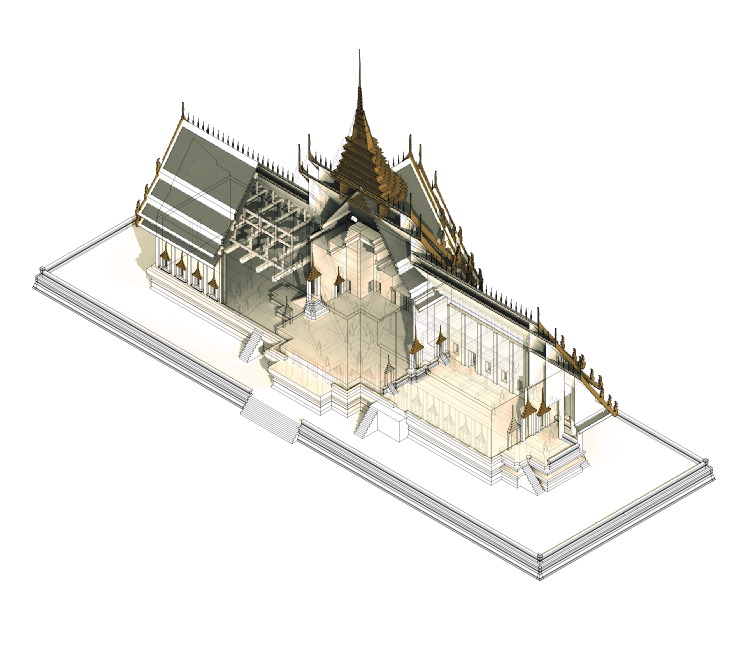
However the left over part was enough to let the viewer envisage the space of what it would look like and how it is used during the period fo Krung Sri Ayutthaya. The transparent Vihara is the state of the Grand Hall before it was destroyed. The image is being overlayed onto the ruin which shares the same layout. The form and material is based on the layout and materiality of the ruin as well as the architectural style of Ayutthaya. The size of the grand hall is the biggest structure in Wat Phra Sri Sanphet because it must house the 16 meters tall golden Buddha Image as well as signifying the absolute power of the monarchy over Krung Sri Ayutthaya.

Most tourists is usually observing the ruin from a distant because most of the part is left open and visible to the eye therefore there is no need for the people to walk inside and observe the ruin. The common type of tourist is foreigners who travel in group tour so that they may understand what it is. The Grand is surrounded by four other ruins which is smaller in size and is used to carry out Buddhist ceremonies by local people during the period of Krung Sri Ayutthaya. The most visited ruin among the five is the Wihan PhraTri Lokanat because it is located before the entrance. The most common point of observation is the front part of the ruin which is the most significant view. Here the user can observe almost every architectural element of the ruin as well as sharing the same sequence of how the space is used before during the period of Ayutthaya. Another common point of observation is from the Chedi Phra Sri Sanphet which enables the user to see the Grand Hall ruin from above. Because the Chedi Phra Sri Sanpet is the most visited ruin in the area, this causes the Grand Hall to be observed as much as well.

The ruin of the Wat Phra SRi Sanphet Grand Hall


the stand of Phra Sri Sanphet were left intacted to the ruin


Sunday, March 23, 2014

Final Research: Sanphet Maha Prasat Throne Hall, Ayutthaya, Thailand


Language is always a collage, borrowing. It is constant evolution but usually have a source. The Sanphet Maha Prasat Throne Hall is one of the significant buildings in Ayutthaya both political and architecture. As a book the palace is a fascinating story that now becomes a lost book. Paradox occurs due to interpretations were made. 
Any translation has mistake but in mistake everything is deviated. Archarological evidences, record, depiction, book, illustration, other Throne hall and replica are studied to visualize matter of fact and matter of concern of this throne hall. 
The throne hall was built by Somdet Phra Boromma Trilokkanat in 1991 B.E. and renovated in 2320 B.E. during Somdet Phrachaoyuhua Borommakot Period. 
  •  Only based of the structure is left nowadays and even it located next to Wat Pha Sri Sabphet but only few tourists visited here. 
  •  The filled ground level misunderstood the visitors. It was filled during the grand palace excavation in Rama V period. 
  •  The accessibility was divided into three levels, the king, Royalties and nobles. 
  •  In the past this throne hall was used to administer, receive envoys and arranged big ceremony such as coronation. 
  • Throne and Umbrella are the most significant elements in the grand palace throne hall. They are used to identify grand palace and palace. 
  •  Wall is load barring wall. It was influenced from western during late Ayutthaya period. 
  • Roof structure called ‘Ma Tang Mai. Only temple and palace can use this structure. It is adaptation from Khmer’s stone structure. 
  •  Garuda is symbolic of ‘King is demi god’ derived from Brahmin. 
  • Layer roof with delicate Kranok pattern indicates the owner dignity. The top peak roof called ‘Yod Prasat’. It is    symbol of grand palace throne hall and representing the importance part in this throne hall. 
Chakri Maha Prasat 

prof.Dr. Santi Leksukhum's hypothesis illustration


The drawing of ‘the past’ only bases on Prof. Dr. Santi Leksukhum’s hypothesis illustration which is one’s interpretation. Then what is the level of tolerance? How much deviation is acceptable? And which one is the most reliable? 

Final Research: The Sanphet Mahaprasat Palace, Ayutthaya, Thailand

Drawing of the Sanphet Mahaprasat in the past based on the hypothesis of Dr.Santi Leksukhum,  the replica of the palace at Muang Boran (Ancient City) and information and documents from the Ayutthaya Research Center and the Fine Arts Department in Ayutthaya.

Ruins of The Sanphet Mahaprasat Palace, 2013
 The Sanphet Maprasat Palace is situated within the boundary of the Ayutthaya Royal Palace. The Royal Palace was divided into three distinct areas, the front or the outer, the middle and the rear or the inner. The Sanphet Maprasat is one of the three halls that is located in the middle area.


The The Sanphet Maprasat was built in the reign of King Borommatrailokanat. It was one of the most important structures of the whole Ayutthaya kingdom. It was used for royal purposes such as receiveing ambassadors from foreign countries.

Ruins of The Sanphet Mahaprasat Palace, 2013
It was also used for other purposes. Coronations of significant kings Autthaya, including Phra Phetracha, Phra Chao Sua, Phra Chao Ekathat, Phra Chao Uthumphon, took place here. It also hold the tonsure ceremony during the reign of Phra Phetracha.

The Sanphet Mahaprasat Palace signifies the centralization of power, the power that the monarch holds supreme authority in governing the nation. The architecture of the building symbolizes religious beliefs. The five-tiered roof symbolizes Mount Meru which is the place where the gods reside, and the belief in the idea of the Hindu and Buddhist cosmology. The kings had divine power and were considered an avatar of god, the incarnation of the Vishnu, or more commonly known in Thai as Narayana, the supreme god that preserves, sustains and governs the universe.


Significant events that happened during the time mainly revolved around the aspects of conflicts, trading and foreign settlements. These issues deal with territory, land use, land ownership and transformation of land which have great impacts on the development of the nation. During Ayutthaya period, the Portuguese came and built their quarter, churches and trading stations on a plot of land that was allocated by the king as opposed to the Dutch whose interests laid solely in trading. Their soldiers served the kings of Ayutthaya in exchange for trade privileges. The French’s advancement in technology was applied to the design and construction of fortifications and city walls while the English did not fare very well and had bad relations with the country. The power of Ayutthaya was also challenged by both the internal and external conflicts. Good political relationship with the Portuguese and the Dutch resulted in them volunteering to help serve Ayutthaya in various uprisings. These issues have great impacts on the development of the nation.

Final Presentation: Language of Thai Architecture


Thai architecture could be interpreted as language. One building is a compound set of paragraphs, sentences, words and letters that composing a story. A building can tell matter of fact and matter of concern by Latour. The hidden story behind its skin origin, culture, period, status, hierarchy, duty, power and wealthy.

One story consists of many paragraphs and in one paragraph there are many sentences that narrate different stories and each sentences is a compound of many words. Each word has different meaning and this meaning comes from letters that have different roots combining together to create one meaning.

Every element that is selected to compose a story is crucial to shape the right story.

So if architecture is a language then one must be able to speak it.
The dictionary was designed in 3 dimensional space as Thai architecture has much more dimensions than language. Structure of the dictionary is arranged by resolution of the elements, which are building block, ornament, pattern, material and finish consecutively.

‘Represents a thing in all its complexity’ from Latour’s lecture.  A thing doesn’t have only matter of fact but also contradictory and controversial natures of matter of concern.  A gable of a palace can tell both status, power, hierarchy, wealthy of the owner and art and culture, style, influence, economic in that period. Every element in Thai architecture communicates differently. If one single primary element of Thai pattern changes, the entire meaning and possession will change.

A word in dictionary presents visual, name and root of the element. The position and accessibility of it presents hierarchy and rule that acquired from the architecture’s strict grammar.

Showing all its complexity one can’t read it. Gombrich’s the perception of order explains about the different between seeing, looking, attending and reading. Eyes select only some part to read to attend to look and to see. The resolution of seeing ability decreases respectively to the level of contemporary disable that specific part.

These varieties of visions can guide and teach the audience through the strict grammar.


Language is always a collage, borrowing. It is constant evolution but usually have a source. The Sanphet Maha Prasat Throne Hall is one of the significant buildings in Ayutthaya both political and architecture. As a book the palace is a fascinating story that now becomes a lost book. Paradox occurs due to interpretations were made.

Any translation has mistake but in mistake everything is deviated. Archarological evidences, record, depiction, book, illustration, other Throne hall and replica are studied to visualize matter of fact and matter of concern of this throne hall.
The throne hall was built by Somdet Phra Boromma Trilokkanat in 1991 B.E. and renovated in 2320 B.E. during Somdet Phrachaoyuhua Borommakot Period.


  • Only based of the structure is left nowadays and even it located next to Wat Pha Sri Sabphet but only few tourists visited here.
  • The filled ground level misunderstood the visitors. It was filled during the grand palace excavation in Rama V period.
  •  The accessibility was divided into three levels, the king, Royalties and nobles.
  • In the past this throne hall was used to administer, receive envoys and arranged big ceremony such as coronation.
  • Throne and Umbrella are the most significant elements in the grand palace throne hall. They are used to identify grand palace and palace.
  • Wall is load barring wall. It was influenced from western during late Ayutthaya period.
  • Roof structure called ‘Ma Tang Mai. Only temple and palace can use this structure. It is adaptation from Khmer’s stone structure.
  • Garuda is symbolic of ‘King is demi god’ derived from Brahmin.
  • Layer roof with delicate Kranok pattern indicates the owner dignity. The top peak roof called ‘Yod Prasat’. It is symbol of grand palace throne hall and representing the importance part in this throne hall.

The drawing of ‘the past’ only bases on Prof. Dr. Santi Leksukhum’s hypothesis illustration which is one’s interpretation. Then what is the level of tolerance? How much deviation is acceptable? And which one is the most reliable?

Any language is in constant evolution and change. It is natural of it to evolve. This tolerance needs to be regulated by a specific institution for a specific language.
Thai language is administered by The Royal Institute, Rajchabandittayasatan.
The obligation of the institute is to act as consultant on academic matter,
to compile dictionaries, encyclopedias, terminologies and coin new words
and to establish criteria of Thai usage in order to preserve and promote Thai language.

Likewise, This virtual space acts as consultant on academic matter. It allows archeologists to explore and share their experience to find the tolerance, deviation, regulation, change and evolution of the rich Thai architecture language and also to preserve and promote the language.

In the space audiences will translate their ideas to 3d virtual model using translating tools.  Due to regularness of Thai architecture it can be translated by many tools one is Thai typewriter.

Typewriter can be interpreted as translating tool that translates idea, intangible, to physical, typed paper. To translate the idea the typist has to learn the language.

  •         Ability to write the language
  •         Ability to type and cognitive
The typewriter

  •         Ability to translate to typography
Readers

  •          Ability to read and understand the meaning
During the invention of Thai typewriter two Thai consonants were eliminated because of not having enough keys. The revolution of Thai was the result of translating English typewriter to Thai typewriter and these two alphabets officially disappear from Thai language.

However Typewriter is just an example of all translating tool. This virtual 3d diagram shows the differences between different means of expression. Body languages, verbal, are the most fundamental tools that require the least learning process. The datascape manifests the process of translating idea to physical through wide range of tools both accessibility and sensibility.


The virtual space will teach its language by displaying the learning process step by step according to position of the audience that will be detected by GPS tracker.

Goggle is mediator that leads audience to experience the augmented reality by taking images with video camera, modifying the image based on virtual space and input action then real time displaying it on glasses.

The goggle is attached with motion capture system for real-time analysis of hand movements using infrared cameras.

The augmented space will give the audience pre-conceive idea of what this space does and how to use it before entering.

The circulation of the audience will be controlled by virtual architecture that real time changing to lead the audience through the sequence of perception.

The first stage, the space displays various translating tools. The audience can explore different tools and learn language of each tool before choosing a tool to work with.

Different tools require different language and grammar. For Thai typewriter, it requires abilities to read and type Thai. 

The audience will be taught Thai name of every single element.    

To exploring Thai architecture the audience have to type the virtual typewriter to create 3d space. Using written language to translate your idea.

After learn its language, the typewriter will circulate around that person. This interface allows the audience access to the dictionary to use as reference while exploring the space.
Next sequence, the audience will enter to three-dimensional dictionary. The visitor will learn and understand relationship and rule of each element. To study the element in details, the interface allows to access the specific elements by rearrange the specific part closer the person.

Then, the visitor can explore and experiment Thai architecture. While still access to the dictionary with the interface that circulate around each person

While exploring the regularness of Thai architecture, the grammar will auto correct the composing and also allow revolution of Thai architecture by adding and subtraction the dictionary.

Thanks to the regularness of Thai architecture margin of auto correct and revolution can be found.


Sunday, December 15, 2013

Final Research on " Wat Mahathat : Great Relics of Buddha "

                                                     A S H W A T I   T E R E S A  J O S E P H                                           
                                              Religious Temple at Ancient City Ayutthaya


Wat Mahathat : Isometric Diagram of Past and Present Context

Now as ruins, Wat Mahathat used to be a Temple idolized for major worship containing the Buddha’s relics. Surrounded by canals in the past, the main royal ceremony included the Barge ceremony which included the King travelling from the Grand Hall to offer prayers and sacrifices at Wat Mahathat. Standing as tall as 50 meters, Wat Mahathat symbolized the major religious site within the city. Constant addition of stupas and increment of height to the main prang of the temple was done in order to symbolze the structures grandeur and influence of Buddhism. Sheltering the supreme patriarch, Wat Mahathat emerged as an important monastery and religious centre. History dates it as collapsing twice during the reign of two kings, consequently bothered with theft and robbery as well as beheading the Buddha statues during the Thai-Burmese War.

VI3 Members at Wat Mahathat Ruins
Declared as a World Heritage Site within the Historical Park of Ayuthaya, Wat Mahathat is left as ruins for visitors to observe. However, the structure still remains as a ruin making the main tourist attraction as the Buddha’s head stuck in a Bodhi Tree. The main circulation involves of passing this attraction afterwards proceeding to the grand vihara and later to the actual main prang further passing the monastery structure. Two gates border the site based on an east west axis symbolizing how axial plans developed in Hinduism carrying on to Buddhism. Many stupas of Various heights are placed surrounding the main prang in order to embellish and make the main prang look more huge in size.


 VI3 Members at the Ubosot (Monastery) Ruin                                                                               Wat Mahathat Ruins at Sunset


Research on Past and Present Conditions


Wat Mahathat, the most holy and nominated structure of Ayuthaya City. Containing within the main prang is the Buddha's relic. Constructed mainly of laterite in the lower part to be topped in the upper part with brick and mortar. Now only the base remains, the collapsed part being probably looted after the fall of the kingdom. The prang collapsed twice, second collapse during the reign of King Rama VI. Continuous additions of various types of chedis, stupas were added to nominate the main prang and constant renovations were done in order to make it larger than the other structures. Placing smaller stupas, a clever method approached to make the taller and larger prang to stand out.
Present Wat Mahathat as Ruins : Location of  Market ,People Circulation, Spotlights.
1. Crow Bad Omen: Legend has it that just before when they city had collapsed, two crows had fought above the Wat Mahathat and supposedly died by falling on to the spire of the prang, their body pierced. This was recorded as one of the bad omen for the kingdom.

2. Reconstruction : Wat Mahathat, literally meaning "Great Relics of Buddha" should be constructed as large and elegant as possible (belief) since it houses the Buddhas relic. Built at a before 38 meters that collapsed, it was reconstructed again to reach a critical height of 42 meters in order to signify the religion's importance within the city.(However other sources mention that the new height went up to 50 meters) Mainly the prang collapsed due to the heavily ornate statues of garuda and devas that was built on the upper part of the main prang. However, now it remains as ruin. The base projects on sides hinting the presence of porch which may have been added during later reconstruction.

3. Royal Barge Ceremony : A Boat ceremony where the King had to travel from the Grand Palace in his barge along with other royal people to offer praise and worship to the Buddhas relics. In the past, Mahathat was surrounded by water canals making waterway the only possible way to travel to Mahathat.


4. Vihan Luang : Approximately 40 by 20 metres in size, this main vihan contained a mural painting of Vessantara Jataka. The deisgn of the vihan is known for its Early Ayuthaya era's square pattern with vertical lines. Currently this is the first place that current tourists enter after witnessing the fallen head of Buddha(stuck in Bodhi tree).

5. Ubosot: The Monastery is believed to be constructed  during the reign of King Boromrachathiraj I completed  in King Ramesuans time. This monastery is believed to be the residence of the Supreme Patriarch and other monks that lived nearby in other smaller ubosots. Another bad omen that followed was the consequent deaths of the patriarchs, one after the other that also proved as a bad omen for the fall of the kingdom. Their bodies were laid side by side at Mahathat.

6. Buddha's Relic : The main prang housed the relics of Buddha which made it the foundation and religious symbolic centre of the kingdom. This follows the practice of many countries who follows the Mandala concept where to imitate Mount Meru(centre of Universe) results in a square shaped town layout. Situated at the heart being the Buddha's  relic, which was protected entombed in a crypt beneath the ground (15 meters deep) in a seven layered pagoda, each of different material namely pewter,silver,nag(amalgam of copper and gold), twice of wood with gold spire, crystal layers, dark gamet topped with emeralds and rubies, the innermost gold box with lid containing the relic in sandalwood oil.


7. Beheaded Buddha Statues: Many stone buddha statues are located within the borders which is supposed to convey the life cycles of Buddha reaching to enlightenment. These however were beheaded during the Burmese captivity of the kingdom. Current tourist circulation occurs path through here, where a huge Buddhas statue(not beheaded) is present to which many pray and worship.

8. Buddhas Fallen Head : Stuck in a Bodhi Tree's roots, this proves to be the most attracted spot for tourists to take photographs of. The past recordings say the head might have been fallen from a thief who was stealing it or that it had fallen during the war.

9. Current Market and Ticket Counter : Located on the Southern side of Wat Mahathat is the current Market(small scale) which follows the Ticket Counter (Thai Citizen :20 Baht, Foreigner : 50 Baht).


Wat Mahathat Analysis from Ash Joseph on Vimeo.

Friday, December 13, 2013

Final research: Grand Vihara, Wat Phrasrisanpetch

GRAND VIHARA, WAT PHRASRISANPETCH

Front entrance

 Back entrance

                       
 Leftover structures

                In the early Ayutthaya period, after Wat Phrasrisanpetch was turned into royal temple in King Trilokkanart's era,  it was believed that   the Grand Vihara was built in King Ramathibbadee II, King Trilokkanart's son, which is around 2042 B.E. In the following year, 16 meters tall golden buddha statue, named by the King as 'Phrasrisanpetch statue', was created and put inside the Grand Vihara. In the year 2310 B.E., Ayutthaya was lost to Burmese. As a result, the Burmese burned the whole city and took all the gold in the city. This situation make the whole city damaged as well as Phrasrisanpetch statue. In the beginning of Rattanakosin era, King Rama I changed the location of the statue from the Grand Vihara, Ayutthaya to a Stupa in Wat Phrachetupon, Bangkok to preserved it value.


Drawing showing the information of the past form of Grand Vihara overlapping the present form which is the ruin. The past form was derived from Dr. Sanurr nildech'book,in which he is an expert in Ayutthaya archaeology.

 Activities inside the building in the past were hinted from the remaining ornament.

Final research: Principle Prang, Wat Ratchaburana, Ayutthaya, Thailand


Wat Ratchaburana was founded in 1424 by King Borommarachathirat II of the Ayutthaya Kingdom and built on the cremation site of his two elder brothers. The two brothers had fought to their deaths in a duel for the royal succession to their father. The Principle Prang located in Wat Ratch- aburana, which is the most valuable Prang that was built for the specific purpose of keeping the treasure and dedication. More than 100,000 votive Buddhist tablets were found, as well as gold jewelry with a
combined weight of more than 100 kilo- grams. The vaults inside the main prang also dis- played Buddha paintings, depicting the previ- ous lives of the Buddha. 
 
Isometric Drawing of  Principle Prang.
Isometric Drawing of Section cut of Principle Prang with treasures inside.
In 1957 there were a group of thiefs stole some treasure inside, later they were arrested and there are some mystery consequence happen to them. Then Silpakorn department took out all the treasure into Chao Samphaya museum for the safety and exhibition to the visitors. 
 All the treasure were found in the treasure room, which compose of 3 different layers inside. The first room contain the most valuable treasure.
 
 Treasure was categorize into Buddha statue and Votive tablet, Regalia, Royal articles of use, Robes and Jewelry, and Dedicated and Tribute and Engrave.
 Principle Prang rendering testing with artificial light
Principle Prang rendering testing with natural light (Overlapping) 


Monday, November 25, 2013

Virtual Headset Update


Animation in the process + Final Thesis


Territories of Value
A virtual treasure room for Siam

The Value theory compose of a range to understand how, why and to what degree people value things; whether the thing is a person, idea, object, or anything else.

This project aim to present the virtual treasure room for Siam, the collection of Thai heritage treasure. Giving the new experience of how the object virtually exhibit and kept in virtual age. This new inventive treasure room enhances the relationship between object and visitor. Different perspectives can be interpreted and presented according to the visitor’s evaluation of the value.

To evaluate and interpret the meaning of the value nowadays, we depend on the degree or amount of value that ties to human needs and wants, as well as memories.
What makes a thing valuable? And to whom? How do we keep, exhibit and protect valuable things? And who decides what makes a things valuable or not?

Evaluation of value has been extended from the range of individual personal level to the bigger scale of national level or cultural level, How does a culture agree on what is valuable and not? Example from the museums, the council meeting decision and voting process from the nominated treasures and collections made the criteria of choice.

The matter of fact and the matter of concern were taken a big part of how we perceive the value of the object. Bruno Latour mentioned about the value as matter of fact and matter of concern, example from the object, the matter of fact has it own limit of what it is and The matter of concern were extended out with how we visualize the object.

Thai heritage temple, Wat Ratchaburana, Ayutthaya, Thailand, is the most valuable Phra Prang in Thailand. It was built by King Chao Samphaya in 1424, with the specific purpose to kept the treasure and dedicated to his two brothers. The complexity of value through the layers inside, while approach into the treasure room create the hierarchy and the expression of the shell and the essence part inside Phra Prang. Today simple brick with simple ornament outside show the trace of past time, rich of ornaments with color, shape, form and material. Recently leaded people to the underestimated of the value, but once get inside Prang the value reveals itself through the treasure underneath. Express the different layers from outside surface with ornaments, along with the laterite brick structure and the treasure room innermost. Phraprang was to contain and protect the valuable treasure inside, while it can communicate and express value through the surface. Treasure is a concentration of riches and power, often one that is considered lost or forgotten until being rediscovered. The treasure inside was discovered by Silpakorn department and taken out into Chao Samphaya museum for its own safety and exhibition after a group of thief stole all the treasure. The treasure room today contains no treasure inside, but left the trace of Ayutthaya painting that symbolize the Buddha story.

Museum was extracts each object from its own original environment and transfer into the new site in the museum. All the treasure was kept inside a building in a room and in the glass box, which make people further away to approach and interact with the object through the glass surface.

Today much of value theory is scientifically study, recording what people do value and attempting to understand why they value it in the context of psychology, sociology, and economics.

The complexity of value that ties to our own perception and evaluation was experimented in the Papaya Warehouse, Bangkok. The experiment video shows the gather of antique object in the same splendid place, giving the new experience through the route in each step. The hierarchy shown through the categories of individual value, sociology value and economy value that represent in different hierarchy of information and graphic. Example from the chair, table and poster. Exploring the space inside. The route and the quality of attention, sequence of perception, scanning and looking with different kind of the object and try to extract the value behind it.

Who wants to see the treasures? And why? Why is it important to show and experience treasures of past time? Could be for national and cultural promotion or propaganda, could be for educational purposes, perhaps it could also be for sentimental and emotional reasons.

The value that ties to the memories, which empower the power through the vehicle as a treasure using by King Rama V. The Royal palanquin is now in Bangkok National Museum to communicate the power from the past Ayutthaya history to the present day, the value communicates through the materials and Thai ornaments that symbolize the monarchy. Another contemporary example that can compare with is “The Beast” President Barack Obama’s limousine. The Beast communicated the power through the shell as a skin to protect president inside, with the hidden specific function inside, it symbolize the democracy. Both object ornaments communicate the power and value through the median of the shell and skin of the surface.

As travel along the street, both objects signify the power and variety of value through the journey along the road. To communicate the value of both actual power and visual power, by the level change of the width and height of the road.
The space is to design the complexity in different scale, higher the road is higher actual power, wider of the road is the wider of the visual power. The visitor can experience all the information and meaning through the journey passing both objects along with the street environment from both sides.
The virtual grammars are representing time, location, history, distance, material and value. Also how both object perform and use with people in specific period.

In modern digital age, technology involved being a part of our precious value memories, through the picture and collection of data, bring back and recover to capture the moment anytime.

Leap motion glasses become the evaluation tools of Thai heritage treasure. Tracking the visitor motion and analyze in real-time, the glasses enable the user to see three-dimensional images which give an illusion of depth of perception. Body gesture sends signals to adjust the images seen by the user as they move around their environment.

Now we are able to visualize and interact with the treasure and becoming the part of their existing. This new revolution of dealing with treasures and heritage allows individuals and groups to interact with the objects, and nominate new ones.

In the virtual treasure room, visitors are able to see and interact with Thai heritage treasure that are nominated and voted from people. The collection of treasure located according to the time, location, and procedure complexity. Walking and looking around Phraprang with scatter of the treasure floating around and the collection of data attach to the treasure. Visitor can explore Thai heritage treasure by rotating object and looking through the different information of the specific treasure.

New and contemporary treasures nominated by the registered user. Only Thai register able to get inside the real treasure room one person at a time. Entering by an individual password in order to get inside. Interact with the virtual treasures, nominating and voting treasure would be base on the matter of fact and matter of concern. By voting and evaluating the object base on individual perception, voting criteria and popularity shown on the surface and covered the object.

The virtual treasure room will change the way of how people behave and perceive the collection of the Thai treasure, also contribute and develop new forms of relationship between people and object. Enhancing the collective of information and technology to promote the social dimension of a new digital creativity that link to the actual cultural treasure. Are you ready for the future?